
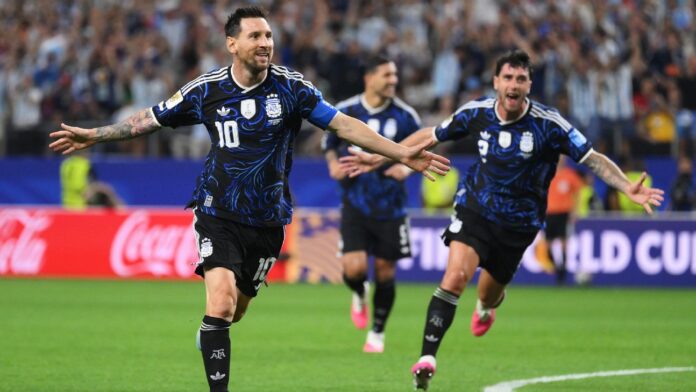

As Argentina captain Lionel Messi took an unusual place on the bench for the final Group J match against Jordan on Saturday night at Dallas Stadium, fans still chanted his name throughout the game.
Argentina manager Lionel Scaloni had already confirmed before kick-off that, with qualification secured at the top of the group, several key players would be rested. The decision was designed to reduce injury risk and give opportunities to test squad depth.
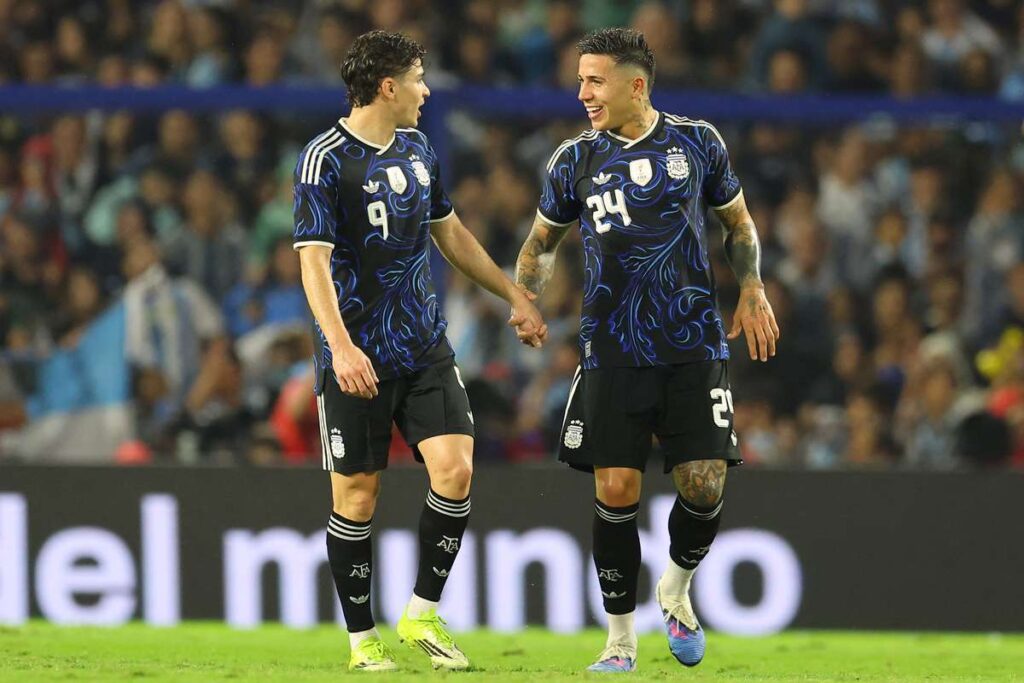
With Messi resting, Scaloni fielded a blend of experienced players and rising talent. Giovani Lo Celso, Giuliano Simeone, Nico Paz and Marcos Senesi all made their World Cup debuts, while veterans such as Nicolás Otamendi (38) and Nicolás Tagliafico (33) provided balance and leadership to a youthful lineup.
“A match to test the squad”
“Today was a match to avoid risking players and to be able to see players who can fill different positions,” Scaloni explained after the game. His strategy worked perfectly, as Argentina national football team secured a comfortable 3–1 victory.
From the opening minutes, Argentina dominated possession, reaching 83% in the first 10 minutes and pushing Jordan deep into their own half. The pressure quickly paid off when Lo Celso opened the scoring in the 19th minute with a well-placed free kick from outside the box.
In Messi’s usual absence from set-piece duties, Lo Celso stepped up and delivered a precise finish, becoming only the second Argentina player to score in the tournament aside from Messi.
Shortly before halftime, striker Lautaro Martínez doubled Argentina’s lead from the penalty spot. He celebrated his first World Cup goal with a symbolic gesture of renewal, signaling confidence in his role within the squad.
Messi enters and makes an immediate difference
Jordan managed to pull one goal back through Mousa Al-Tamari, briefly raising tension in the match. However, in the 60th minute, Messi entered the pitch to replace Martínez, and the atmosphere inside the stadium shifted instantly.
As expected, Messi once again left his mark. He scored with a trademark free-kick, sending the crowd into celebration and extending his remarkable World Cup scoring record.
The goal continued Messi’s historic run, making him the only player to score in seven consecutive World Cup matches. He also extended his tournament total to 19 goals, further cementing his legacy as one of the competition’s greatest-ever performers.
Confidence in the squad depth
After the match, Lo Celso praised Messi’s influence on the team, saying that watching him daily motivates the squad and raises overall performance levels.
Statistically, Argentina finished with 12 shots, 73% possession, and an expected goals (xG) value of 2.13, reflecting their dominance throughout the match.
Despite Messi’s partial absence, the performance reinforced a key message: Argentina can still control and win matches without relying solely on their captain.
Looking ahead to Cape Verde
Argentina now prepare to face World Cup debutants Cape Verde in Miami in the round of 32. The underdogs impressed in the group stage, holding teams like Spain, Uruguay, and Saudi Arabia to draws and finishing second in Group H thanks to their disciplined defensive structure.
However, Scaloni remains confident in his squad’s approach.
“We always focus on ourselves; any opponent is tough,” he said. “We have to try to do maximum damage to the opponent with our best weapons.”
For Argentina, the match served as both a warning and a reassurance: even when rotating heavily, and even when Messi starts on the bench, the reigning champions remain a formidable force capable of delivering on the biggest stage.