
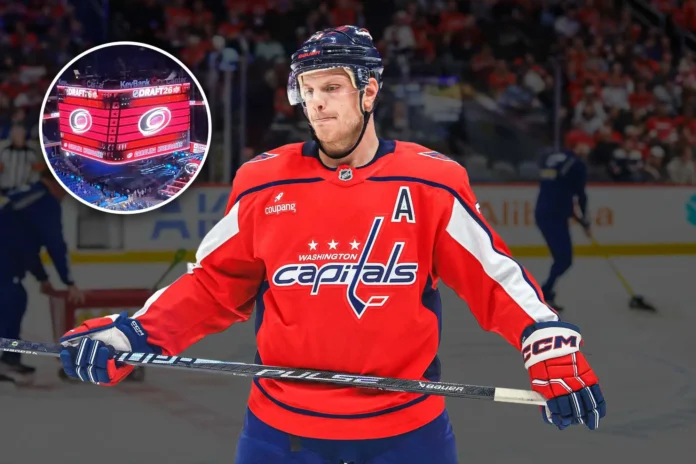

The Stanley Cup champion Carolina Hurricanes made an aggressive early-offseason move on Saturday, acquiring the negotiating rights to veteran defenseman John Carlson from the Anaheim Ducks in exchange for prospect Kyle Masters and a sixth-round draft pick.
The move does not yet guarantee Carlson will play in Carolina, but it gives the Hurricanes a valuable exclusive window to negotiate with the 36-year-old blueliner before unrestricted free agency officially opens. This type of trade is often used by contenders to get a head start on the market and lock in priority discussions with sought-after veterans.
Why Carolina made the move early
For the Hurricanes, this is a classic “win-now” maneuver. With an established defensive core already built around structure, puck movement, and transition play, adding Carlson would immediately address two priorities: power-play production and right-shot stability on the blue line.
Carolina’s system relies heavily on defensemen who can push pace and support offensive zone possession. Carlson, even in the later stage of his career, still profiles as a high-end puck mover with strong power-play instincts and a proven track record of driving offense from the back end.
At 36, he remains productive: he posted 60 points in 71 regular-season games split between Washington and Anaheim, along with 14 goals. That scoring touch remains valuable for a team that occasionally struggles to generate offense in tight playoff games.

What “rights to a free agent” actually means
By acquiring Carlson’s rights before free agency opens, Carolina essentially gains a short exclusive negotiating period—typically a few days—before other teams can speak with him.
This window allows the Hurricanes to:
- Discuss contract terms without bidding competition
- Gauge Carlson’s interest in returning to the East
- Potentially finalize a deal before the market inflates his price
However, if no agreement is reached, Carlson still becomes an unrestricted free agent and can sign with any team.
Cap space and contract expectations
Carolina is reportedly working with roughly $11 million in available cap space, giving them flexibility to structure a multi-year deal if necessary. Carlson’s next contract is expected to reflect both his production and age curve—likely in the short-term range (2–3 years), with an AAV that could land in the mid-to-high single-digit millions depending on incentives and structure.
The Hurricanes’ decision to use assets (a draft pick and prospect) for negotiation rights signals they are comfortable being aggressive rather than waiting for the open market.
Fit with the Hurricanes’ defensive structure
If a deal is completed, Carlson would likely slot into a top-four role, potentially anchoring the second pairing and running the second power-play unit—or even sharing first-unit duties depending on deployment.
Carolina already features a deep defensive group, but lacks Carlson’s specific blend of veteran right-shot offense and elite-level power-play quarterback experience. His presence could help stabilize postseason scoring droughts, something that has occasionally limited the Hurricanes in deep playoff runs.
Current internal competition on the blue line includes several established NHL defenders, meaning Carlson would not be forced into a carry-heavy role—an important factor at his age.
Anaheim’s motivation for the trade
For Anaheim, the deal is a low-risk asset recovery move. Rather than potentially losing Carlson for nothing in free agency, they convert his negotiating rights into a draft pick and a prospect.
Given that Carlson was acquired only ahead of last season’s trade deadline, Anaheim’s priority now is roster flexibility and long-term asset accumulation rather than retaining veteran UFAs.
Career context and market value
Carlson’s résumé remains one of the strongest among pending defenseman free agents. A longtime cornerstone of the Washington Capitals earlier in his career, he brings:
- Over a decade of top-four NHL experience
- A Stanley Cup championship pedigree (2018 Capitals)
- Proven playoff production and leadership
- One of the more consistent offensive defenseman profiles of his generation
Even as his skating has declined slightly with age, his decision-making, puck distribution, and power-play instincts remain highly valued across contending teams.
What happens next
The next 24–72 hours are critical. Carolina will attempt to finalize terms quickly before Carlson can engage with other contenders. If a deal is completed, it would immediately rank among the more impactful early-offseason defensive acquisitions.
If not, Carlson becomes one of the most sought-after right-shot defensemen on the free-agent market—likely driving a bidding war among playoff-caliber teams looking for a veteran upgrade on the blue line.
Either way, this move confirms Carolina’s intent: they are not just defending a championship window—they are actively reinforcing it.