
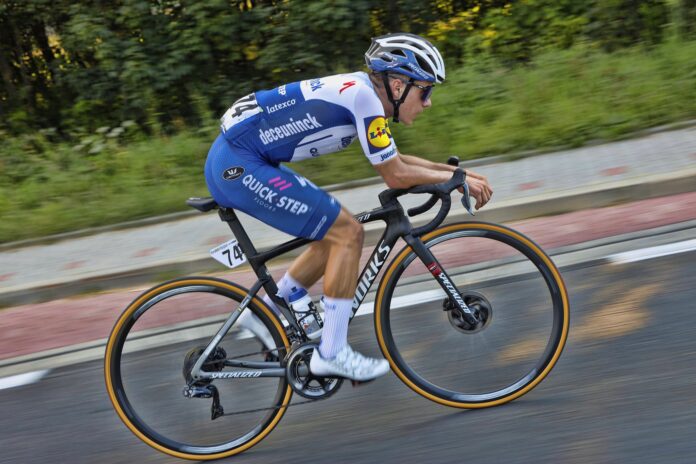

Five days after standing on the Tour de France podium in Paris, Remco Evenepoel is back in the saddle and pointed at the Basque Country. The 26-year-old Belgian arrives at Saturday’s Clásica San Sebastián as the clear favourite, carrying the momentum of the best Grand Tour performance of his career and the opportunity to write his name alone into the history books of one of cycling’s most demanding one-day races.
Evenepoel finished second overall at the 2026 Tour de France behind Tadej Pogačar, 6 minutes and 26 seconds back on the Slovenian at the final classification in Paris. It was the best general classification result of his career and his highest-ever finish at the race, built on two standout stage victories: a summit finish win at Plateau de Solaison on Stage 15 and a dominant individual time trial on Stage 16 between Évian-les-Bains and Thonon-les-Bains, where he beat Pogačar by 28 seconds — the best time across every single checkpoint. In Paris, he spoke with the quiet confidence of a rider who had proved something important to himself. “I’ve shown I deserve to dream,” he told journalists on the Champs-Élysées, adding that second place had confirmed his belief that winning a Grand Tour is not merely an ambition but a realistic goal.
Now he turns that form toward the steep climbs of the Basque Country.
The Clásica San Sebastián is not just another race on the calendar for Evenepoel. He has started the event three times and won it three times, taking victories in 2019, 2022 and 2023. He currently shares the all-time record for victories at the race with Spanish legend Marino Lejarreta. A fourth win on Saturday would make him the outright record holder — the most successful rider in the history of an event that has been running since 1981.
The course, stretching over 200 kilometers with more than 4,250 meters of climbing and seven categorised ascents, suits Evenepoel’s particular combination of time trial power, climbing ability, and tactical intelligence. The decisive moment will almost certainly come on the brutally steep final ascent of Jaizkibel or on Erlaitz, where pure climbers will be forced to make their move if they want to dislodge the Belgian. If Evenepoel reaches the final kilometer in a small group, few riders in the peloton can match him in an explosive sprint finish.
The only genuine unknown surrounding him is recovery. Three weeks of Grand Tour racing place a significant physical toll on the body, and Evenepoel will be racing again just five days after the Tour finished. Red Bull-Bora-Hansgrohe has brought a strong supporting cast to San Sebastián, with Primož Roglič, Giulio Pellizzari and Maxim Van Gils also on the start list, giving the team tactical flexibility should the Belgian show any signs of residual fatigue.
The challenger list is long and credible. Defending champion Giulio Ciccone of Lidl-Trek returns to the Basque Country having soloed to victory last year, though his preparation since the Giro d’Italia has been limited and he is not considered to be in peak form. Lenny Martínez of Bahrain Victorious finished the Tour de France in outstanding condition and is suited to the course’s steep, punchy climbs. Quinn Simmons, Mauro Schmid, Jan Christen, and Jhonatan Narváez all bring finishing speed that could matter if a select group reaches the line together.
The race takes place on Saturday, August 1. If Evenepoel is anywhere close to the form he showed on the roads of France, the question in San Sebastián will not be whether he can win, but whether anyone in the field is capable of stopping him from doing it.